Milan absorbed about 215,000 sq m of offices in the first nine months of 2026, less than in 2025. Average vacancy is 9.8%, grade A vacancy 3.7%. For the stock left behind, the question is the cost of bringing it back to market.
Between January and September Milan's office market absorbed about 215,000 square metres, according to JLL, plus 9,600 square metres of subleases. That is below 2025. The third quarter, at 82,000 square metres and up 20% year on year, looks like a recovery but includes an owner-occupier deal of about 24,000 square metres that has little to do with leasing demand.
Rome moved the other way: 100,000 square metres, 17% more than a year earlier, driven by eight leases above 5,000 square metres and above all by EUR, which alone accounts for 40% of take-up. The public sector remains the main source of demand.
Two markets in one index
Vacancy explains Milan. The third-quarter average is 9.8%, but for grade A buildings it drops to 3.7%. In Rome the gap is sharper still: overall vacancy below 7%, grade A at 1.5%.
JLL's summary does not split the stock by quality, but arithmetic is enough: if the average is 9.8% and the best segment stands at 3.7%, the rest must be above average. And that is where demand is not going. About 70% of Milan's take-up involved grade A, sustainable, well-located buildings.
Scarcity shows in rents. Prime reached 840 euro per square metre per year in the Duomo CBD and 800 in Porta Nuova, and leases above 600 euro made up 22% of space absorbed. Rome's prime stands at 620 euro. Milan's average deal has shrunk to about 900 square metres, and deals between 5,000 and 10,000 square metres are rarer. Companies take less space, want it better and sublet what they do not need.
What it costs to bring a building back
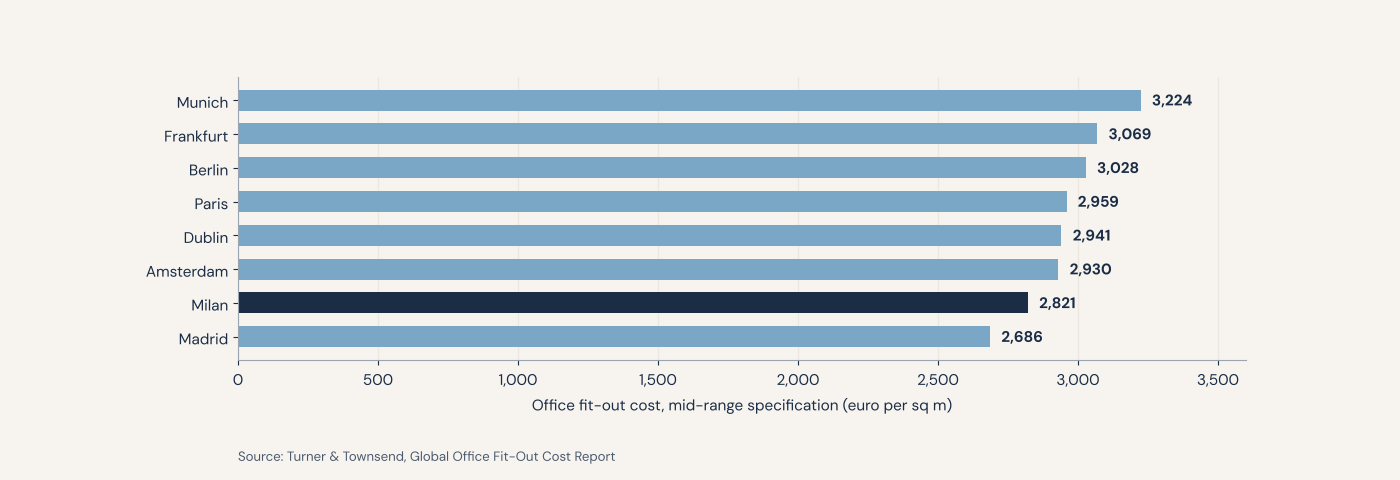
For owners of mid-quality buildings the problem is financial before it is architectural. Turner & Townsend's Global Office Fit-Out Cost Report puts Milan's average interior fit-out at 2,821 euro per square metre for a mid-range specification, 2,193 for a basic one and 3,682 at the top end. Construction accounts for 1,923 euro; the rest is fees, furniture and audiovisual equipment.
These are interior costs only. A full repositioning, with envelope, central systems and green certification, costs more.
Milan compares well. It is cheaper than Munich (3,224 euro), Frankfurt (3,069), Berlin (3,028) and Paris, Dublin and Amsterdam, all just under 3,000. Only Madrid, at 2,686, costs less. Construction cost inflation in Milan is expected to hold at 2% in 2026 and 2027, against 4% in Munich and 6% in Madrid.
Set against rents, the picture sharpens. At an 840 euro prime rent, a mid-range fit-out alone equals more than three years of rent; at 600 euro, almost five. In semi-central or peripheral locations, where rents are lower, payback lengthens, and with the ECB raising rates again so does the cost of financing the works.
Renovate, convert or wait
Turner & Townsend sets out the owners' options: renovate, change use, or let the building lose value year after year. The third is the most common and least visible, because vacancy in an ageing building builds up quietly until a valuation records it.
The geography of demand leaves some room. In Milan the semi-centre took 34% of space absorbed, the periphery 27% and the hinterland 10%, as occupiers who cannot find prime space in the centre move out. They move to refurbished buildings, though, not to ones left as they were.
For Milan, the nine-month figures describe a stock that in large part no longer matches what companies want, and an upgrade cost that prime rents justify only where those rents are actually achievable. In Rome, with grade A vacancy at 1.5%, the same game will be played on regenerating existing stock, as JLL itself acknowledges. In both cities the value of mid-quality offices will depend less on the market at large and more on whether they can realistically be lifted above the line that now divides the two segments.