The housing debate has moved onto the stock: too many dwellings in the wrong places, too few where they are needed, conversion as the answer. The diagnosis holds, yet the gap is widening mainly on the income side, and no refurbishment plan closes it alone.
Writing in VareseNews on 3 August, Mauro Colombo, chief executive of Artser, made a point that is both correct and unpopular: Italy is not short of houses. It has more than 35 million of them, roughly three quarters occupied by residents. The issue is not quantity. That stock was built for households that no longer exist, and it struggles to become housing for the people looking for it today. Colombo calls this real estate illiquidity, and the term fits.
The diagnosis holds. It describes half of the mechanism, though, and not the half that broke first.
Two diverging lines
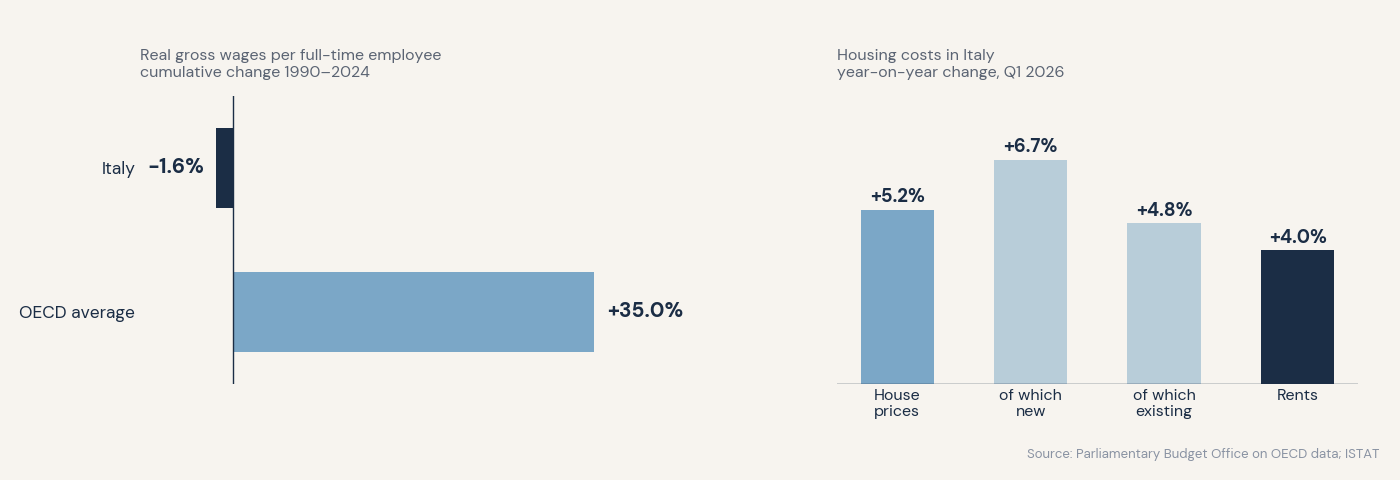
In the first quarter of 2026 the ISTAT house price index rose 5.2% year on year, with new dwellings at +6.7% and existing ones at +4.8%. Rents grew by around 4%, averaging some 14.8 euros per square metre, close to record levels. In the same country, the Parliamentary Budget Office calculated that between 1990 and 2024 real gross wages per full-time employee fell by 1.6%, while the OECD average rose 35%. Part-time work went from just over 4% of the employed to roughly 30%, and in more than half of cases it is not a choice.
The cost of housing climbs, the ability to pay for it declines, and the two lines have been moving apart for thirty-five years. Much of what gets called a housing cost problem is a wage problem in disguise, which is why measures built purely on the supply side keep falling short.
Where the argument needs correcting
Saying that income is the binding constraint is only half right, and the missing half matters. Income governs affordability as long as supply responds. Where it does not, and in Milan it does not, a pay rise capitalises into land values within a few cycles: this is Ricardian rent, and the gain accrues to the landowner rather than to the tenant. The two explanations are not alternatives, they operate in series. Income sets the aggregate level of affordability; the elasticity of supply decides who captures its growth.
Hence the limit of the "refurbish, don't build" formula. At national scale it is sound. At metropolitan scale much less so, because reactivating underused stock in a weak-demand area houses nobody in Milan. Housing demand is co-located with employment; buildings stay where they were built, and conversion does not move them.
Retrofit is not housing policy
One effect is almost always left out of the debate. The push towards reuse does not come from affordability, it comes from decarbonisation: the European directive on energy performance imposes renovation trajectories on the worst-performing stock, the new Minimum Environmental Criteria in force since February require selective deconstruction with recovery of at least 70% of materials by weight, and the ISTAT construction cost index stood at +3.3% year on year in April 2026. All of this raises the unit cost of works, and therefore the break-even rent, absent full subsidy. The Superbonus demonstrated the point in the most expensive way available. Selling refurbishment as the answer to the housing emergency means adding together two objectives that in practice subtract from one another.
Then there is scale. The national Piano Casa allocates 970 million euros to the refurbishment of public housing: at an average intervention value of around 32,000 euros, that means some thirty thousand units brought back into use. Sensible against the problem of vacant public dwellings, marginal against the waiting lists, in a country where public housing remains below 4% of total stock, against shares three to seven times higher in Austria, Denmark and the Netherlands. The constraint is one of ownership and institutions before it is one of funding.
The missing metric
The demography Colombo cites correctly, eleven million people living alone by 2050 and average household size below 2.1, does not describe a maintenance problem. It describes a typology problem. An inherited 110-square-metre flat in a weak-demand municipality does not turn into a managed studio or an assisted-living bed on thirty-two thousand euros of works: the permitted use changes, the regulatory framework changes, the economics change. That is why valuation demand is shifting towards the formats existing stock cannot supply, from senior housing to small managed rental units, rather than towards undifferentiated refurbishment of ordinary residential property.
One measure almost never appears in planning documents: how many hours of work it costs to live somewhere. As long as that number worsens, any housing plan is working on the symptom.