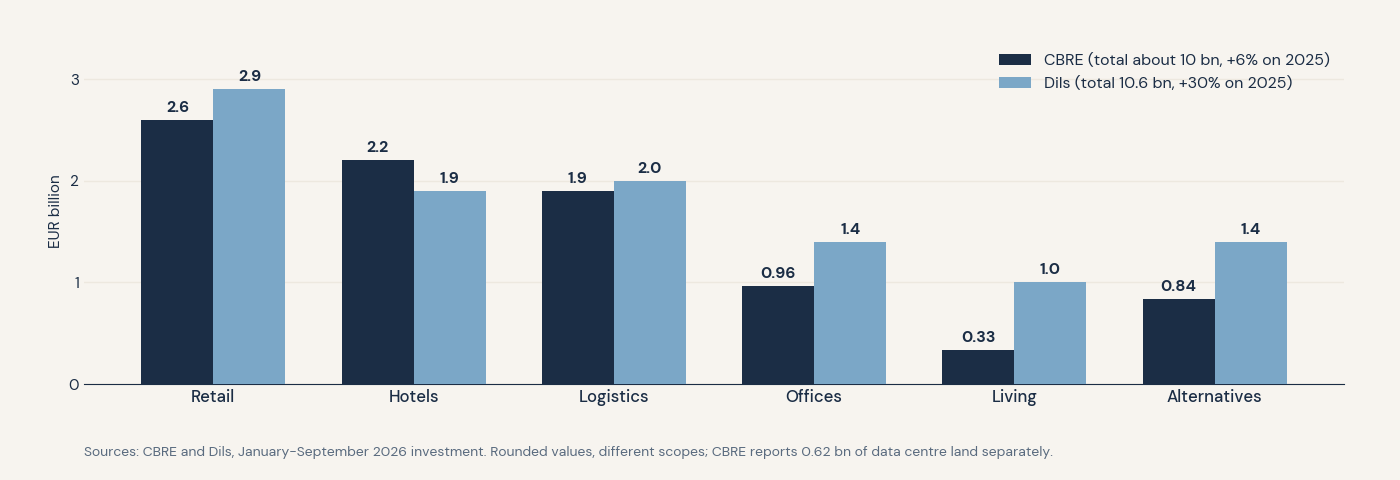
CBRE and Dils agree on the volume invested in Italy in the first nine months of 2026, about 10 billion euros, but one sees +6% and the other +30%. Hotels and logistics lead, regional markets account for 74% of the quarter and prime yields are starting to move with rates.
On 8 October two leading consultancies released their figures on real estate investment in Italy for the first nine months of 2026. According to CBRE, commercial real estate attracted about 10 billion euros, 6% more than in the same period of 2025, including 2.8 billion in the third quarter. Dils counts 10.6 billion, up 30%, with 3.1 billion in the quarter, enough to exceed the ten-year annual average already in September.
On the level, the two sources are close. On the pace, far less so.
Where the gap comes from
The difference does not lie in the quarter just ended: CBRE reports +21% on the third quarter of 2025, Dils +18%. It arises entirely in the first half. In July both estimated the half-year at around 7 billion, but CBRE compared it with an almost identical first half of 2025 and reported +2%, while for Dils the same level meant +28%. The 2025 baseline differs, and the likeliest reason is scope: land, developments, share deals and owner-occupier purchases are counted differently.
Living makes this clear. CBRE puts the sector at 334 million over nine months, down 48%, with land acquisitions of about 336 million, including Santa Giulia, booked separately. Dils puts living close to one billion, up 35%, because it includes build-to-sell purchases by developers. Office estimates also diverge, 964 million against 1.4 billion. No public register allows the figures to be reconciled, so the direction is reliable while the size of the growth calls for caution.
Hotels, logistics and the regions
On who leads the market, the sources agree. For CBRE hotels were the top asset class of the quarter, with 815 million (+114%) and about 2.2 billion year to date. Some 79% of quarterly hotel volume went outside Milan and Rome, driven by two resorts in Como and Olbia, and resorts now account for more than half of the sector's investment. Dils, at 1.9 billion, names hospitality the most dynamic sector of the period.
Logistics is the other pillar. CBRE records 757 million in the quarter and 1.9 billion since January, the second-best result ever after 2022. Occupier data are the strongest: about 2.3 million square metres taken up in nine months, 811,000 in the third quarter alone. With scarce supply, prime rents are rising, to 73 euros per square metre for CBRE and 75 in Milan for Dils.
Regional markets absorbed about 2.1 billion in the quarter, 74% of the total.
Milan remains the office benchmark but lacks product. Nine-month take-up fell 22% according to both sources, despite a stronger third quarter, and prime CBD rents hit new highs: 850 euros per square metre for CBRE, 900 for Dils. Rome, with 6.3% vacancy and take-up up 28%, is the more active office market.
The rate question
The most sensitive part of both reports concerns the cost of money. CBRE refers to a marked rise in policy rates, so far offset by competition among lenders. Dils already sees a slight rise in prime net yields in some asset classes and mentions the prospect of a new tightening cycle.
Deals closed over the summer were largely negotiated earlier, and the effect of rates on values comes with a lag. It is also uneven. Where rents are rising, as in logistics or owner-operated hotels, higher yields can be absorbed by income. Where income is flat or value depends on development, as in living and land, sensitivity is higher. An alternative hypothesis, which year-end data will test, is that the announced pipeline supports the fourth quarter at pre-hike prices, pushing the adjustment into 2027.
A cautious reading
2026 is on track to close above the ten-year average, and on this the reports leave no doubt. Whether it is moderate growth or strong acceleration remains open, because the answer depends on the 2025 baseline. For allocation decisions the composition matters most: capital is moving towards assets with growing income and towards regional markets, while development-driven segments remain the most exposed to the next moves in rates.