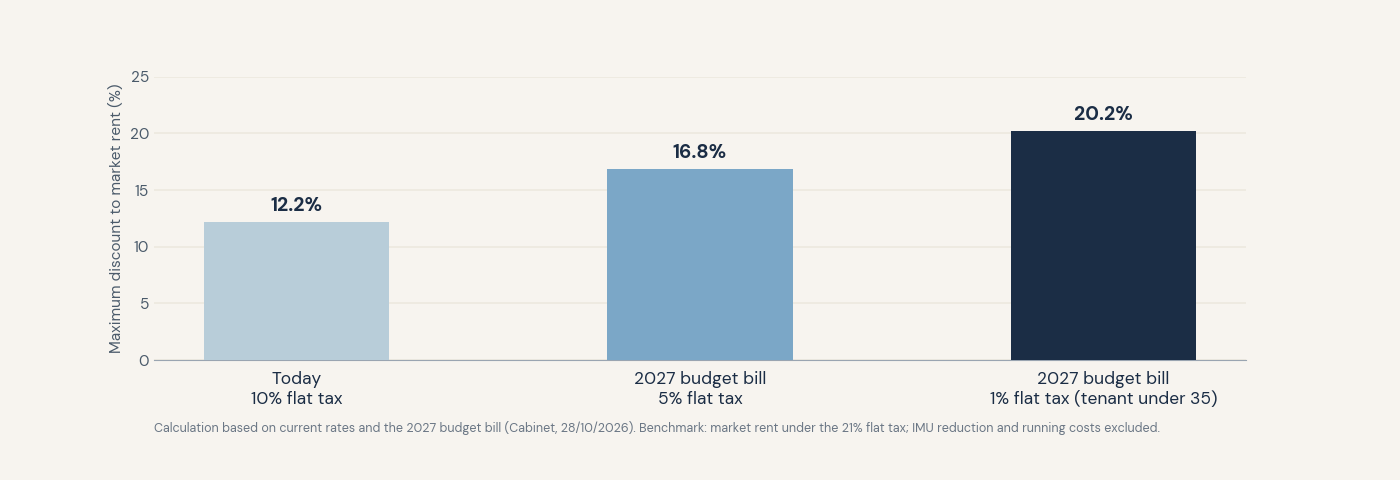
The budget bill approved on 28 October cuts the flat tax on regulated rents from 10% to 5%, and to 1% for tenants under 35. For the same net income, a regulated rent can now sit up to 17-20% below market, against 12% today.
On 28 October the Cabinet approved the 2027 budget bill. Three housing measures were announced: an extension of renovation tax credits at 50% for main residences and 36% for other properties, a 21% flat tax on rents for shops in cadastral category C/1 under 300 square metres, and a much lighter flat tax on regulated (canone concordato) residential leases. The rate falls from 10% to 5%, and to 1% when the tenant is under 35.
That last measure changes a calculation many landlords make whenever a flat becomes vacant.
The landlord's arithmetic
A regulated rent must fall within bands set by local agreements between landlord and tenant associations, area by area. It is almost always below market rent, and the gap varies widely between neighbourhoods. In exchange the landlord gets a lower tax rate, a shorter lease (three years plus two instead of four plus four) and, by law, a 25% cut in IMU.
The practical question is what discount to market rent leaves the landlord indifferent in net terms. Under the 21% flat tax on a market lease, the landlord keeps €79 of every €100 of rent. At today's 10% rate, a regulated lease breaks even if the rent is no more than 12.2% below market. At 5% the threshold rises to 16.8%. At the 1% rate for under-35s it reaches 20.2%.
Take a flat that would let for €1,000 a month on the open market. A landlord accepting €850 on a regulated lease today nets €765, against €790 on a market lease. Under the new rates the same €850 would net €807.50, or €841.50 with a tenant under 35. The comparison flips.
The calculation leaves out the IMU reduction, which tilts things further towards regulated leases, and arrears risk, which has nothing to do with the tax regime.
Where the measure really bites
The threshold has to be set against the actual gap between local bands and the market. Where that gap stays within 15-17%, regulated leases become the better option for almost every landlord already using the flat tax. Where market rents have outpaced the agreements, as in several central districts of the most expensive cities, the gap can be far wider and none of these rates closes it. There the outcome depends on whether municipalities and associations update the bands. The tax incentive is set in Rome; the permitted rent is decided locally.
Short lets and long lets
Much commentary has focused on a possible shift away from short-term lets. For short lets the flat tax stays at 21% on the first flat and 26% on the second, with a presumption of business activity from the third. The gap with 5% is wide, but in a tourist area a short let can generate gross income several times that of a regulated lease, and a few points of tax will not reverse the comparison. Any shift is likely to involve marginal units: less touristic areas, low occupancy, owners tired of day-to-day management.
What the text still has to settle
The figures come from the government's statement and early press reports; the bill and its passage through Parliament may change them. Several practical points remain open: how the tenant's age will be verified, what happens when the tenant turns 35 during the lease, whether the 1% rate survives renewal, and whether the cut applies to existing leases or only new ones.
A threshold to compare with local agreements
For a landlord the choice comes down to two numbers: the discount required by the local agreement and the break-even threshold set by the tax rate. The bill moves that threshold by almost five points, eight for under-35s. Where bands have stayed close to the market this will move a meaningful number of leases; where they have fallen behind, the real lever remains updating the agreements.