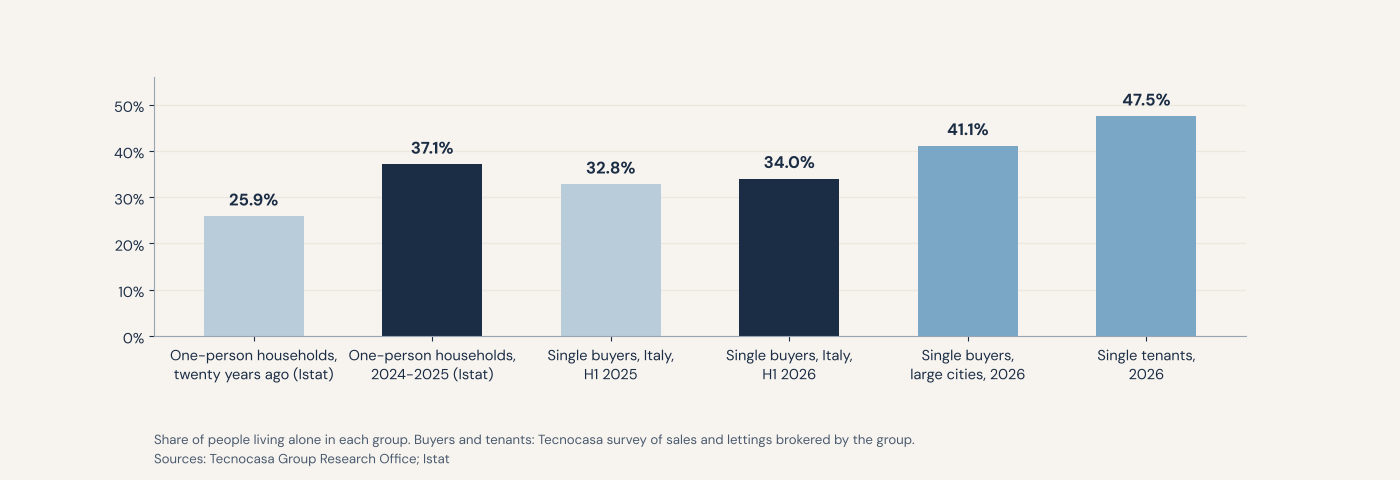
According to Tecnocasa, people living alone made 34% of purchases in the first half of 2026, and 41.1% in large cities. Yet singles buy more three-room flats than two-room ones, and almost half take a mortgage on a single income.
In the first half of 2026, 34% of homes sold in Italy were bought by someone living alone, up from 32.8% a year earlier. The figure comes from the Tecnocasa Group's research office, which describes it as the highest in recent years.
In large cities the share rises to 41.1%, and exceeds 47% in Milan and Turin. Rome, Bari, Genoa and Florence are above 40%; Naples stays below 30%.
Behind this lies a slow change in household structure. According to Istat, one-person households made up 37.1% of the total in 2024-2025, against 25.9% twenty years ago.
More households than buyers
Side by side, the numbers say something less obvious than the headlines. Singles are 37.1% of households but 34% of buyers: they still buy less than their weight. The imbalance is clearer in renting, where the same survey puts them at 47.5% of tenants.
Part of that demand is temporary by definition. Among single tenants, 30.6% are relocated workers and 8.1% university students.
Rent the two-room flat, buy the three-room one
The figure that most contradicts developers' habits concerns unit types. Singles mostly buy three-room flats, 36.4% of purchases, up from 35% in 2025. Two-room flats stop at 32.9%, while four-room flats and detached homes account for about 12% each.
The survey does not say why, so the reasons are hypotheses. The extra room is for working from home or hosting a child who lives with the other parent. Or it is prudence: someone buying alone, on one income and often for the only time in their life, picks the size that will resell to the widest pool.
The two-room flat remains the natural rental format, and a growing share of singles buy to let: 15.7%, against 14.8% a year ago. Main homes account for 80.6% of purchases, second homes 3.7%.
For residential developers the implication is concrete. A unit mix built on the equation single equals two rooms risks attracting mostly investors and missing the first-home demand of people living alone, who want more space.
One income, one instalment
Credit is the other shift. In 2023-2024, 59% of singles bought without a mortgage. Today that share is 51%, and borrowers have risen from 41% then to 47.9% in 2025 and 49% this year.
The constraint is arithmetic. With 2,000 euro net a month and an instalment of a third of income, at ABI's September average rate of 3.61%, a 25-year loan comes to about 130,000 euro. Two equal incomes reach about 260,000. With the same deposit, a single buyer starts with half a couple's purchasing power and no second salary to fall back on.
A three-room flat on one income in Milan or Turin requires savings, the sale of a previous home or substantial family help. The half buying without a mortgage presumably has one of these. The other half is the most exposed to rate moves, with one pay packet behind the instalment.
Broad demand, tight budgets
Singles will keep gaining weight in the market, pushed by demographics more than by taste. Tecnocasa's data, though, show demand with two traits that pull apart: it wants larger homes than is often assumed and has less spending power than its share suggests. Product and price will have to reconcile the two. In cities where singles are already close to one buyer in two, the gap between what gets built and what this demand can afford will show up in time on the market.