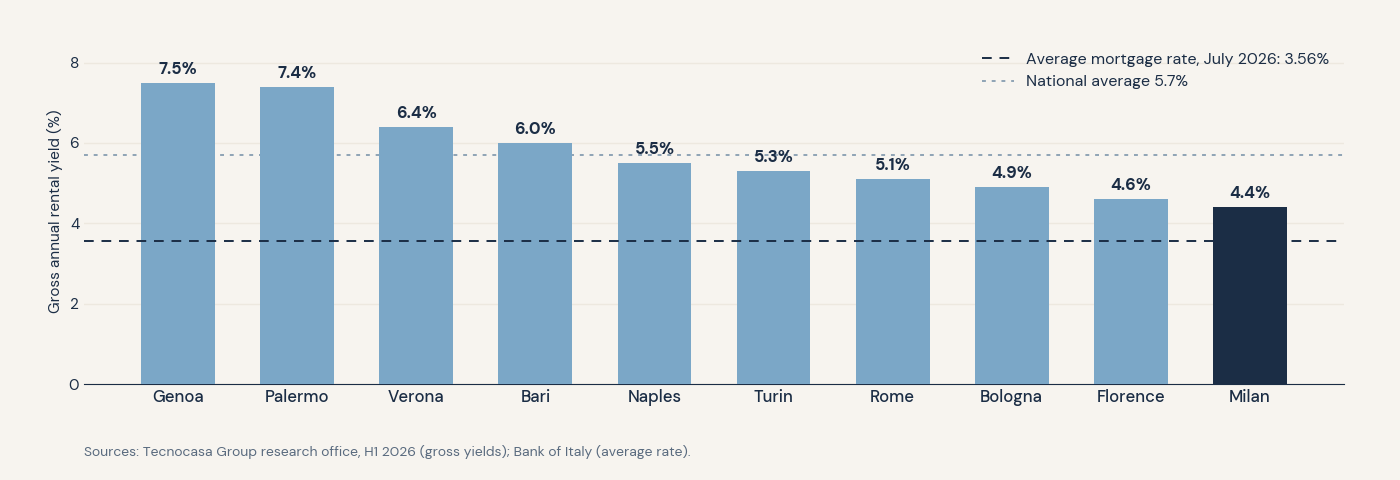
In the first half of 2026 resale prices in Milan fell 0.5% according to Tecnocasa, and rents lost almost two points. With a 4.4% gross yield, the lowest among large Italian cities, and mortgages at 3.56%, the investor's numbers no longer add up. What this means for prices.
Milan has closed a half-year in negative territory for the first time in this cycle. The drop is small: 0.5% on resale prices in the first half of 2026, to an average of 4,489 euros per square metre, according to data presented on 7 October by the Tecnocasa Group research office. On its own it would say little. Read alongside the rest of the report, it describes a market that has reached a limit.
Every signal points the same way.
Average selling times rose to 92 days. Rents fell across all sizes, by 1.9% for studios and one-bedroom flats and by 1.4% for two-bedroom units. The historic centre lost 0.6%, while two outer districts held up, Lodi-Corsica at +0.8% and Fiera-San Siro at +1.5%. The most telling figure concerns those who leave: only 38% of Milan residents buying a home do so within the city. In 2019, 35% bought outside; today it is 62%.
The investor's arithmetic
The timing makes sense once you look at yields. Tecnocasa estimates gross annual rental yields in large cities: Genoa at 7.5%, Palermo at 7.4%, Verona at 6.4%, a national average of 5.7%. Milan comes last at 4.4%. The average mortgage rate recorded by the Bank of Italy in July was 3.56%.
The gap is under one point, and it is gross. Property tax, major maintenance, non-recoverable costs, void periods and income tax all come off. For a one-bedroom flat let at market rent, the net yield often ends up around 3%. Anyone buying in Milan today with a mortgage in order to let pays more on the debt than the property returns: negative leverage.
For years capital growth made up for this. Between 2016 and 2026 Milan prices rose 58.6%, the highest among large cities, and a thin running yield was the entry ticket to that appreciation. With prices flat and rents falling, the compensation disappears on both sides at once.
What controlled-rent contracts reveal
Leases offer a clue. In Milan the share of controlled-rent contracts jumped from 10.2% in 2025 to 31.4% in the first half of 2026, after the local agreement raised the rent caps. These contracts carry a 10% flat tax and lower property tax: landlords are looking to tax relief for the return that rents no longer provide.
Credit is less clear-cut. Home purchase lending reached 25.5 billion euros nationally in the half-year, down 4.9%, but the fall is almost entirely due to refinancing, down 62%, while purchase mortgages grew 3.5%. Fixed rates still dominate, though their share slipped from 94.2% to 84.8% and variable rates rose from 0.5% to 5.6%. Some households are betting on lower rates. Buy-to-let investors have less room to wait.
Closer to household income
There is also a limit unrelated to rates. A 70 square metre flat at the average resale price costs about 314,000 euros, while the average mortgage in Italy is 128,510 euros. Even assuming larger loans in Milan, the gap must be bridged with savings or family wealth, and that pool does not grow with prices. Under-34s make up 39% of Milan buyers and singles over 48%, which also explains why one-bedroom flats attract 44.7% of demand.
Asking-price data agree. According to idealista, resale prices in Milan fell 1.7% in the third quarter, to 5,659 euros per square metre. Other listing-based trackers show broad national increases, and there is no contradiction: the rest of the country, led by Verona (+4.9% in the half-year) and Turin (+3.7%), is still rising, and Tecnocasa expects national prices to grow 3% to 5% in 2026.
What is left of the cycle
A 0.5% fall over six months is modest. It does show that Milan prices now depend on what owner-occupiers can afford, because the investor's margin has narrowed to nothing. Markets changing regime this way tend to move little and for a long time, with slower negotiations, more frequent discounts and a widening gap between efficient homes and the rest of the stock. Growth, meanwhile, is shifting to where gross yields still exceed the cost of money by two or three points.