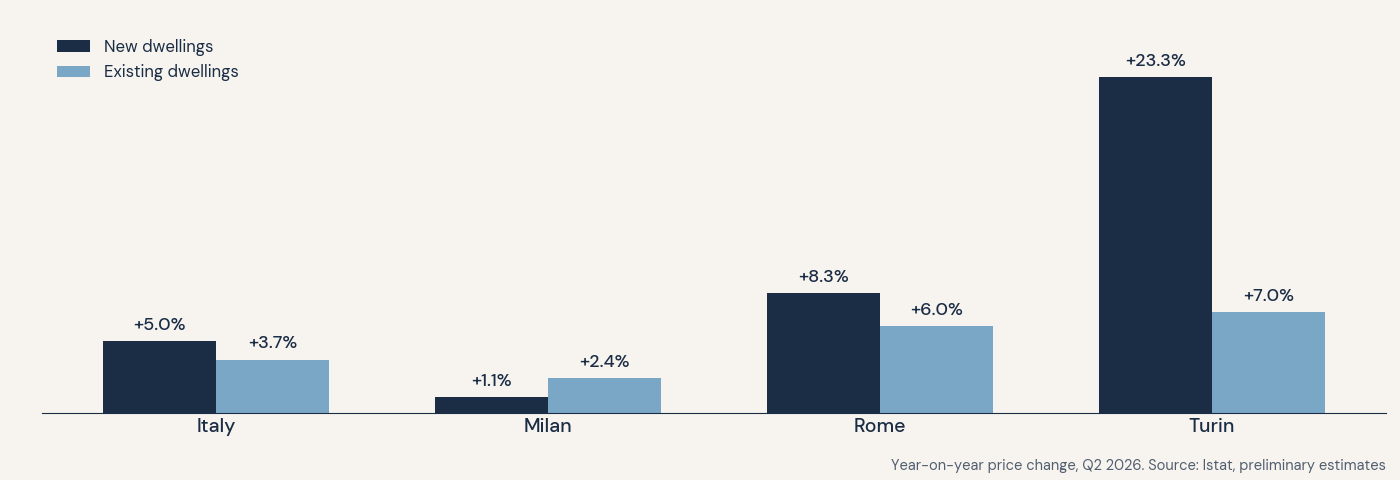
Istat's preliminary second-quarter 2026 estimates show Milan new-build prices up 1.1% year on year, after +20.1% at the start of the year. Turin posts +23.3%, Rome +8.3%. At least three explanations fit, and the data cannot yet separate them.
In the first quarter of 2026, new homes sold in Milan cost 20.1% more than a year earlier. In the second quarter the year-on-year change fell to 1.1%. Nineteen points in three months, in the segment that had driven the city's index for two years.
The figure comes from Istat's preliminary house price estimates, released on 17 September. Nationally the index rose 4.0% year on year, down from 5.1% in the previous quarter, with new dwellings at +5.0% and existing ones at +3.7%. Every macro-area slowed: the North-East sharply, from +6.3% to +4.2%, the Centre barely, from +5.2% to +5.1%.
Three cities, three paths
The large cities tell a less tidy story. Turin moved from +3.8% to +8.5%, with new homes at +23.3% after a 2.8% fall in the first quarter. Rome accelerated from +5.5% to +6.4%. Milan dropped from +7.1% to +2.4%, and within that slowdown existing homes held up better than new ones: +2.4% against +1.1%.
Normally new stock outpaces resale, because it carries energy rating, systems and design quality the existing stock rarely offers. In Milan, in the second quarter, the relationship reversed.
The most quoted reading
Most commentary points to one cause: the investigations into planning permissions have hit new product specifically, slowing sites and deliveries and denting buyer confidence. The hypothesis is plausible. Anyone buying off-plan in Milan today prices in the chance that the building permit is challenged.
At least two alternative explanations cannot be ruled out with the data available.
One is statistical. If the jump in Milan's new-build price level was concentrated in spring 2025, the April-June 2026 comparison starts from a high base and the annual rate deflates even with flat prices. Without the quarterly level series for Milan, the size of this effect cannot be measured.
The other is composition. City-level new-build indices rest on far fewer deeds than resale indices, and the mix reaching completion in a given quarter swings more than methodology can fully neutralise. Turin illustrates it. Going from -2.8% to +23.3% in three months describes which schemes were handed over, more than it describes a market.
What holds either way
Volumes first. According to the Revenue Agency's property market observatory, Milan home sales were flat year on year in the second quarter, while new-build sales nationally rose 15.6%. People in Milan are buying as much as a year ago. New-build prices have simply stopped running.
Then resale, which slowed but remains positive and now outpaces new stock. For anyone appraising a development, the gap between new and refurbished resale prices is what justifies demolition and rebuild. When it narrows, margin shrinks before construction costs even enter the calculation.
Finally, duration. One quarter is not a trend, and the estimates are provisional.
Two readings, two land values
If the investigation hypothesis is right, the signal reaches beyond Milan: permitting risk, treated so far as a cost of time, would have started to pass through to sale prices, shifting part of it onto the end buyer.
If base and composition effects dominate, the slowdown is a normalisation.
The two readings lead to opposite conclusions on Milan land values. Anyone pricing a site today on 2025 exit values is betting, usually without saying so, on the second.