The shift to fixed rates shielded households from the rate hikes. A Bank of Italy study of 2015-2025 shows where the risk went instead: smaller down payments backed by a state guarantee, and borrowing costs that now fall mainly on those who have yet to buy.
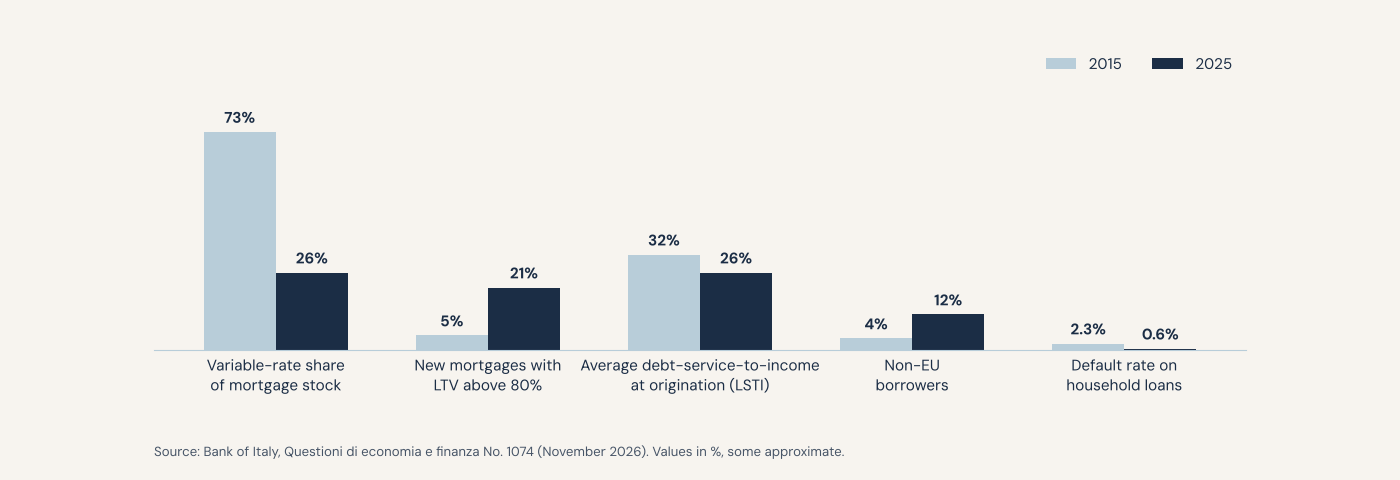
In 2015 almost three in four outstanding Italian mortgages carried a variable rate. By the end of 2025 that share had fallen to 26%. The figure comes from a Bank of Italy paper published in November that reconstructs a decade of residential lending, and on its own it explains why the 2022-2023 tightening did not turn into a wave of defaults. Most borrowers were paying a fixed instalment, and the rate rise stopped at the contract. Read alongside the Financial Stability Report released on 13 November, the paper also tells another story. The risk is still there. It has simply moved.
How much buyers put down
The average new mortgage rose by more than 10% from 2015 to €156,000 in 2025. The loan-to-value ratio says more. Average LTV at origination went from just under 60% to a peak of 72% in 2022 and has settled around 70%. Loans above 80% LTV were 5% of the flow in 2015; in 2025 they were just over 21%.
Much of that jump is due to the first-home guarantee fund. In 2025 about 15% of new loans carried the 80% state guarantee, and nearly nine in ten high-LTV loans have additional cover.
For the bank, expected losses on thin-equity loans stay contained. For the system as a whole the picture differs, because part of the potential loss now sits on the public balance sheet.
Debt service relative to income has stayed prudent: 32% in 2015, 23% in 2020, back to around 26% in 2025.
Who is borrowing
Since 2022 borrowers under 36 have signed 46% of new contracts. The share of non-EU borrowers has tripled, from 4% to 12%. These are households with little wealth behind them, for whom the down payment is the real hurdle. Credit quality shows no cracks for now. The default rate on household loans fell from 2.3% in 2015 to 0.6% in 2025, the lowest in the series, against a peak of 3.4% in early 2009. Non-performing mortgages are 1.2% of the stock.
Vintages not yet tested
One finding helps keep these numbers in perspective. The riskiest vintages, ex post, were those written in 2015-2017, years when average LTV was still below 60%. Mortgage risk surfaces years after signing.
The 2022-2025 vintages, the most stretched on LTV, have not yet been through falling incomes or falling prices.
The Bank of Italy sees no significant vulnerability. In the November baseline, the share of debt held by vulnerable households would rise to 9.3% in 2027, moderate by pre-pandemic standards. Still, the two documents show where to look if conditions changed: high-LTV, state-guaranteed loans rather than the old variable-rate stock.
The long-rate channel
There is a flip side. A market that lends almost only at fixed rates passes long-term rates straight through to new buyers via swap rates. The November report notes a considerable rise in long yields; the 10-year BTP opened at 4.43% on 16 November, with the spread about 50 basis points above its January lows.
For the stock, fixed rates are a shield. For those still to buy, they are the channel through which borrowing costs reach the instalment.
By European standards Italy remains lightly indebted. Mortgages are about 20% of GDP; 76% of households own their home and 17% have a mortgage, against 74% and 40% in Spain; prices rose 18% in ten years, against 86% in Spain.
The structure absorbs shocks to existing borrowers well and tends to shift them onto future demand, into volumes rather than bad loans.