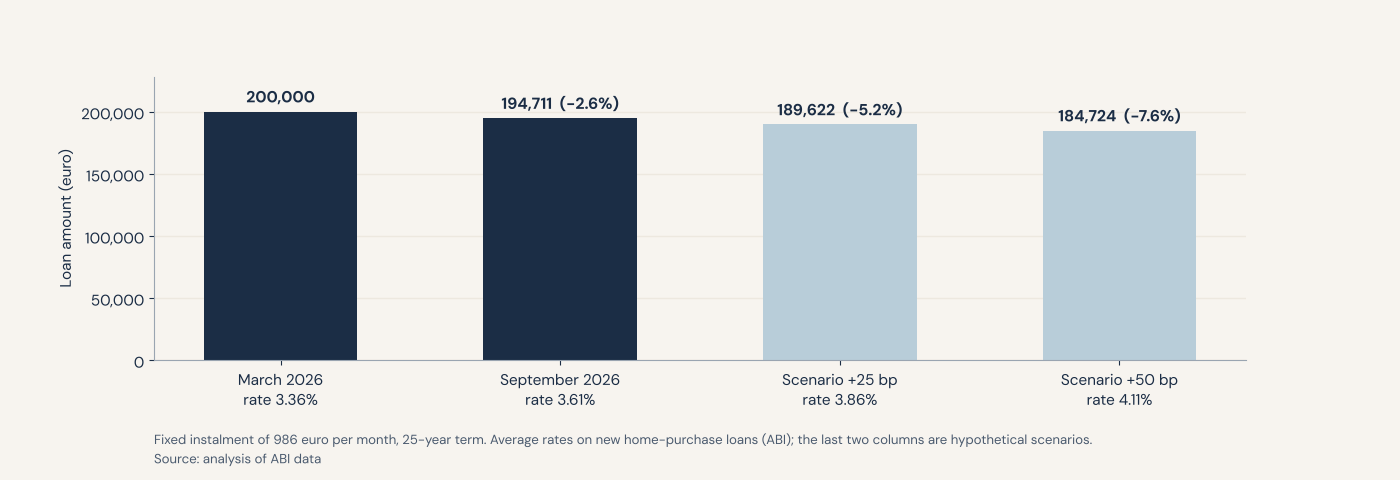
According to idealista, second-hand home prices fell 0.9% in October, with declines in 81 of 112 provincial capitals. Between March and September, at an unchanged monthly instalment, higher rates cut the amount a household can borrow by 2.6%.
In October asking prices for second-hand homes in Italy fell 0.9% from September, according to idealista's monthly report, to a national average of 2,012 euro per square metre. The quarterly decline is the same, while prices are still 1.5% higher than a year ago.
The breadth matters more than the size. Prices fell in 81 of 112 provincial capitals, rose in 27 and were flat in 4. Milan slipped just 0.1%, Rome 0.3%, Naples and Bologna 0.9%. Florence, Bolzano, Venice and Verona kept rising, and six cities set new highs.
One month is not a trend, and portal asking prices are not transaction prices. But the signal comes just as credit has turned.
Six months of rising rates
The ECB raised its deposit rate from 2% to 2.25% in June and to 2.50% in September, then held on 29 October. Part of the market still expects another move in December. Banks had moved earlier. According to ABI, the average rate on new home-purchase loans rose from 3.36% in March to 3.61% in September. The Bank of Italy's APR, which includes fees, reached 3.99% in August, the highest since August 2024.
Twenty-five basis points sound small. In monthly payments they are not.
The maths at a fixed instalment
Take a 200,000 euro, 25-year loan. At 3.36% the monthly payment is about 986 euro; at 3.61% it is 1,013. Twenty-seven euro a month will not break a household budget, but buyers reason the other way round: they start from the payment the bank considers affordable and work back to the price. Keep it at 986 euro and, at September's rate, the loan shrinks to about 194,700 euro, 2.6% less.
At the same loan-to-value, the same buyer can offer 2.6% less for the same home. A further 25 basis points passed fully to mortgages would take the loss to 5.2% against March; 50 basis points to 7.6%.
Where the gap goes
If borrowing capacity has fallen by more than two and a half points while asking prices are still above last year, the difference is absorbed elsewhere. Term is the first valve. CRIF reports that 67% of new loans in 2026 run beyond twenty years, and at 3.61% stretching from 25 to 30 years finances about 216,700 euro with March's payment. The rate rise vanishes from the monthly bill and reappears in total interest and five extra years of debt.
The deposit is the second valve, which favours buyers with savings or family help. The third is moving. Tecnocasa's survey of about 23,000 first-half transactions shows that in 2019 75% of big-city residents bought their main home in their own municipality, against 60% today. In Milan only 38% buy within the city, and the share of investment purchases there fell from 30% to 23% in a year.
Then there is waiting: CRIF recorded 5.9% fewer mortgage applications in the first half than a year earlier.
A slowdown at different speeds
Idealista links the slowdown to inflation and tighter credit. The map of declines hints at something more, though monthly data cannot prove it: where many purchases are made without a mortgage, as in tourist markets and art cities, the cost of money matters less and prices can keep rising while the rest of the country stalls.
Price is the last variable to adjust. Loan terms lengthen first, searches widen and investors step back. If the ECB hikes again in December and banks pass it on, the gap between what households can pay and what sellers ask will be harder to bridge through term alone. If the cycle stops here, October's dip may remain an adjustment of a few points, spread over many months and very different from city to city.