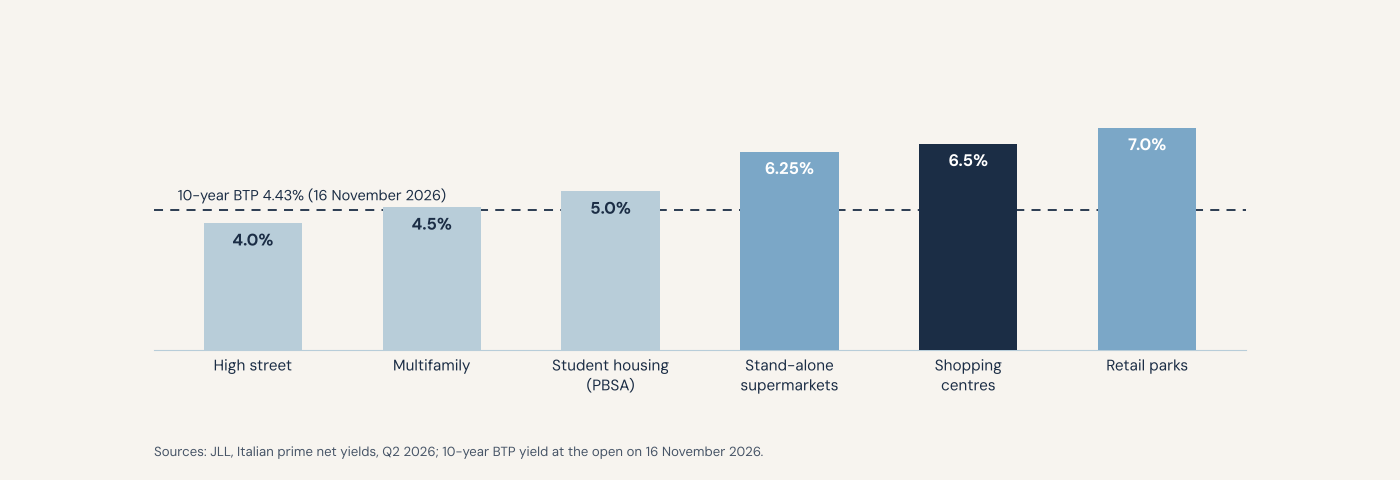
Prime shopping-centre yields sit about 200 basis points above the 10-year BTP. Deals by M Core and Klépierre show who is capturing that premium and on what terms, while sources disagree on where yields are heading.
Between the 6.5% prime net yield on a shopping centre and the 4.43% on the 10-year BTP there are about 200 basis points. Among Italian property sectors, only retail parks offer a wider gap. That is the simplest reason why a segment written off a few years ago is back at the top of the investment rankings.
The 2026 figures confirm it. According to Dils, retail drew about €2.9 billion in the first nine months, up 29% year on year and the best January-September result in a decade. In the third quarter alone shopping centres accounted for some €420 million, 70% of retail. CBRE, using a different scope, counts €2.6 billion.
Two buyers, one profile
In July the UK group M Core entered Italy by buying four assets from Morgan Stanley and HIG for about €300 million: Grande Cuneo, Grande Sud near Naples, Etnapolis in Catania and Brinpark in Brindisi.
The three larger centres total some 121,000 sqm of lettable area, fully let, with 16 million visitors in 2024. The capital came from the €2.3 billion sale of the group's French industrial platform.
Klépierre, which closed on Casamassima near Bari at the end of 2025 targeting a high single-digit cash return from year one, signed in October to buy Finiper's 50% of their joint venture.
The price is €196 million for Il Leone in Lonato and Il Destriero in Vittuone, closing by 31 December. Il Leone is set for an extension that adds food and beverage space.
The common thread is plain. Buyers want centres that dominate their catchment, fully let, with a capex plan already drafted.
What the premium pays for
The spread over BTPs prices risks the market still sees as high: online competition, reliance on a few large tenants, physical obsolescence. For prime centres those risks have eased. The CNCC-EY monitor shows sales up 2.2% in the first half and footfall up 1.7% over nine months. Across Europe, Savills reports prime-centre vacancy down from 9.7% to 9.1% in 2025, the first fall in a decade. But the premium is quoted on a prime benchmark, while the risk spreads across the whole stock. CNCC counts more than 1,270 centres in Italy, and operators openly separate the top tier from the weaker mid-market. Whoever buys a dominant asset at 6.5% collects a spread priced partly with assets in mind that the buyer would never touch.
Compression or stability: the sources diverge
The data do not point the same way. Savills reports compression in prime shopping-centre yields over nine months. Dils, for the third quarter, notes slight rises in prime net yields in some sectors without naming them. JLL had them stable at 6.5% at the end of June; another survey early in the year put them at 6.75%.
Such gaps are normal among observers working on few trades and on valuations rather than prices. In a segment with a few dozen deals a year, though, they matter for the size of the premium, and neither reading can be ruled out. Compression with BTPs near 4.4% would take the spread below 200 basis points from the property side. A continued rise in long rates, flagged by the Bank of Italy, would narrow it from the other.
Value is made on site
That is why the entry yield explains little on its own. This year's deals rest on a second act: refurbishment, extension, re-letting, more room for food and beverage, which generated €5.7 billion of sales in Italian centres in 2025 according to Deloitte for Aigrim-Fipe and CNCC.
Every extension goes through planning variations, regional retail permits and often a new standards calculation. That is where the 200 basis points either turn into value or are used up by waiting.