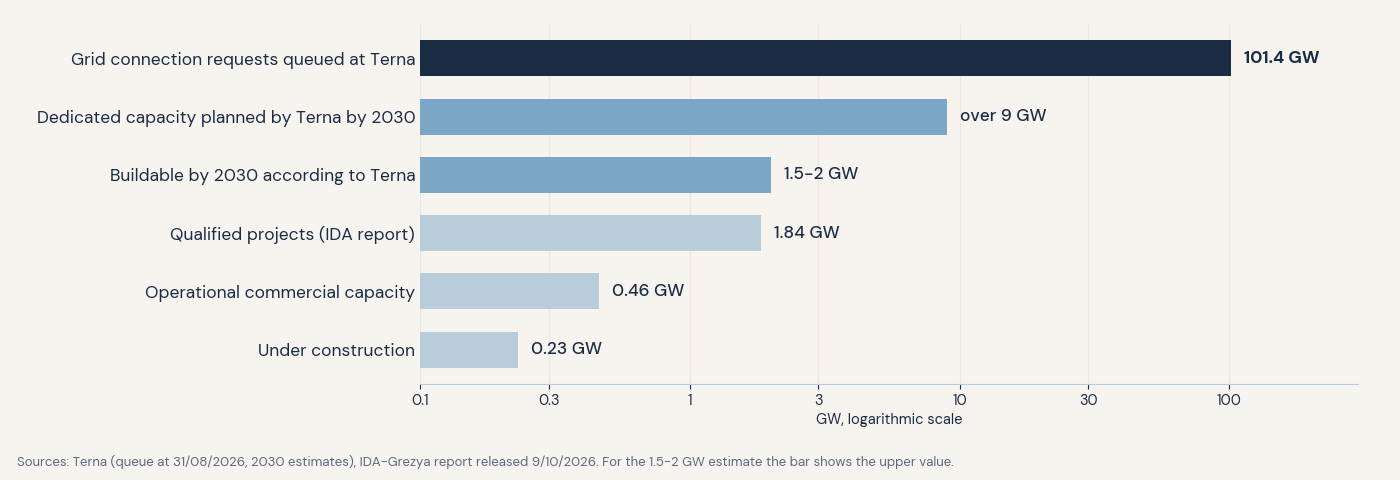
Connection requests to Terna have passed 100 GW, but realistic projects for 2030 are counted in single digits. In between sits a land market trading places in the queue rather than plots.
On 14 October Terna's chief executive, Pasqualino Monti, put a number on what operators had been saying for months: more than 100 gigawatts of grid connection requests for new data centres, spread over almost 600 initiatives. At 31 August the queue held 553 applications for 101.36 GW, against 69 GW at the end of 2025. Monti reads it as a vote of confidence in the Italian grid. In the same statement he recalled that renewables went the same way, with requests far beyond what could actually be built.
From queue to construction site
According to the report commissioned by the Italian Data Center Association (IDA) and presented in Rome on 9 October, Italy runs 460 MW of commercial capacity today. Qualified projects add up to 1,839 MW, but only 230 are under construction: 673 are in development and 936 at a preliminary stage, meaning buildings bought with no design or permitting under way. Terna considers the queue unrealistic and expects 1.5 to 2 GW to be built by 2030, while planning more than 9 GW of dedicated connection capacity.
Between request and construction there is a factor of fifty to four hundred, depending on the denominator.
Why the queue swells
Requesting a connection is cheap. IDA's president, Luca Beltramino, told MF that 2,500 euros is enough, whether the application concerns 100 or 200 megawatts. Terna connects on a first-come basis, subject to complete documentation, and cannot reject a formally correct request at the outset. A Tom's Hardware reconstruction in late August estimated that 60% of applications came from property companies, logistics operators and private owners with no declared industrial project.
The practice is land banking. The owner of a warehouse or a disused industrial site files the request, waits for the grid operator to indicate a technical connection solution and sells the land with that value built in. A plot with a high-voltage solution already indicated is worth more than the same plot without one, often by more than an ordinary zoning change would add.
What changes hands is a place in line.
Who bears the cost
The cost falls on those who actually want to build, since a property application filed earlier goes ahead of an industrial project filed later. IDA has asked for stricter rules, its own members included: guarantees proportional to requested capacity, full cover above 100 MW, connection fees paid in tranches linked to progress. Terna has proposed making the connection solution final only once there is a demonstrated intention to build. If these rules pass, the implicit premium on many sites will deflate, and buyers who paid for the connection as a given will find themselves holding an option.
How much weight the estimates can bear
The sources do not match. Terna speaks of 1.5-2 GW by 2030; one of its managers cited 2-3 GW of actual grid withdrawals at a conference earlier this month; the IDA report puts commercial capacity at 2-2.3 GW by 2031, up to 3.4 GW with extra demand it describes as not yet secured. IT power, grid withdrawal and commercial capacity are measured differently and cannot be added up.
The opposite hypothesis also remains open: part of the queue may hide undeclared hyperscaler projects that will surface only once a connection is secured. It is hard to verify from outside, and the past offers little support. The Politecnico di Milano observatory found that investment in 2023-2025 reached 7.1 billion euros, 68% of the 10.5 billion forecast in 2023.
Concentration, by contrast, is a firm fact. Milan hosts 376 of the 460 operational commercial MW, and Lombardy accounts for over 46 GW of requests across 290 applications.
The value sits in the grid
For anyone owning or appraising industrial land, zoning still matters but no longer explains price on its own. Distance from a substation, residual local grid capacity and expected time to connection now weigh as much, and they enter valuations unevenly. Once the queue rules tighten, the market for grid-ready land will split between sites with a project and an end user, and sites with nothing more than a filed request.