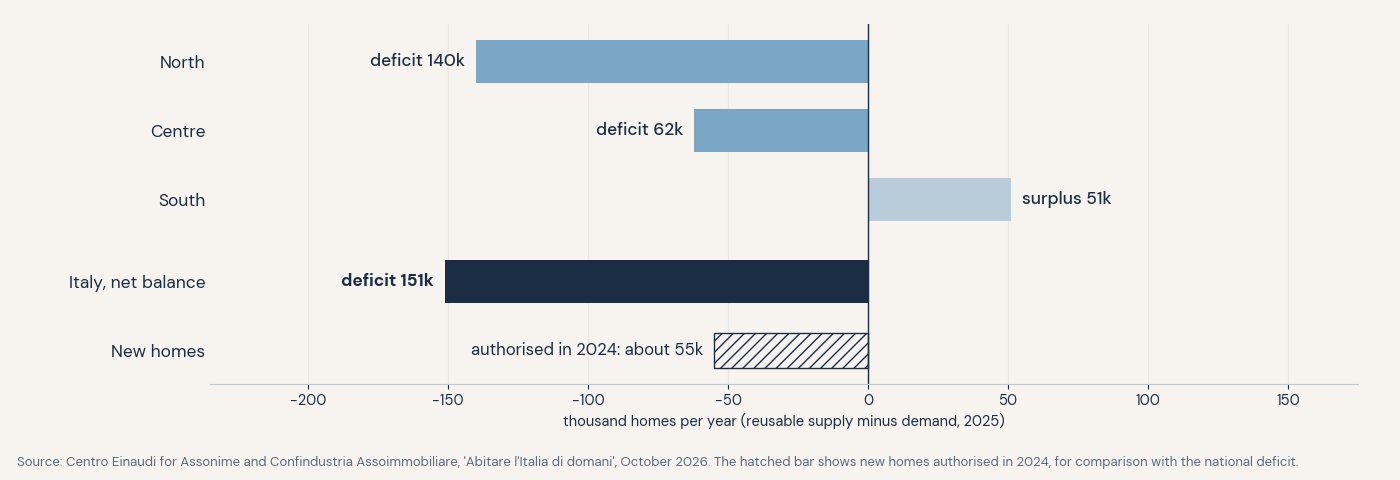
A Centro Einaudi report for Assonime and Confindustria Assoimmobiliare estimates an annual deficit of 151,000 homes in a country with 35.6 million dwellings. The issue is where they are, not how many.
A country with 35.6 million homes and fewer than 26 million households that needs 151,000 new homes a year. Put like that, it sounds like a paradox. The report «Abitare l'Italia di domani», produced by Centro Einaudi for Assonime and Confindustria Assoimmobiliare and presented in Rome on 13 October, resolves it with a turnover model simple enough to be argued over.
How the figure is built
The model starts from gross demand: about 1.013 million homes in 2025, from new households, job moves, immigration and other needs. On the other side is the supply released each year, but only part of it counts. A reusability coefficient reflecting location, construction period and energy performance leaves 862,000 homes. The difference is net need.
That coefficient is the decisive step. A vacant house in an Apennine village does not meet the demand of a nurse just hired in Bologna.
Deficit in the North and Centre, surplus in the South
The North shows a deficit of about 140,000 homes a year and the Centre 62,000, while the South has a surplus of reusable supply of around 51,000. Metropolitan areas weigh most: 100,000 missing in the metropolitan North, 45,000 in the metropolitan Centre. Southern cities are short too, but on paper the surplus in outlying areas offsets them.
The national figure is an algebraic sum of two different problems: homes missing where the jobs are, and homes standing where jobs are scarce.
The report also cites an estimate of 8.5 million "dormant homes", 25.7% of dwellings owned by individuals. They are often presented as a reserve to be mobilised, and the study is clear that they are not automatically one. Occupancy is 84.5% in cities, against 55% in rural areas and 53.1% in inner mountain areas.
Output is not keeping up
Against 151,000 homes needed, just over 55,000 new homes were authorised in 2024. Even doubling output would fall short, so the report puts subdivisions, changes of use, deep renovation and reuse of existing stock at least on a par with new construction. The physical state of the stock complicates this: 32.4% of homes predate 1961, another 56.3% were built between 1961 and 2000, and 45.3% of the homes certified for energy performance in 2024 were in class F or G.
The planning knot
For anyone working on urban transformation, the most relevant proposal concerns the rules. Many parameters on density, height and distance still derive from Ministerial Decree 1444 of 1968, written to govern expansion rather than densification. The report calls for a thorough revision, simpler procedures and fixed timelines, and links volume bonuses to shares of social or below-market housing in high-need areas.
That is close to the approach of the Piano Casa, which the study endorses in principle with three reservations: tax treatment of professional letting that is still not structural, resources and delivery capacity yet to be tested, and governance perhaps too centralised to pick the right buildings. Programmes using private capital must put at least 70% of investment into price-controlled housing, at least 33% below market, with a thirty-year restriction. Whether planning bonuses offset those obligations is something no operator has yet stated publicly with figures.
The report projects need falling to about 73,000 units by 2040, for demographic reasons. That is a long horizon for a market whose tension is measured today in big-city rents.