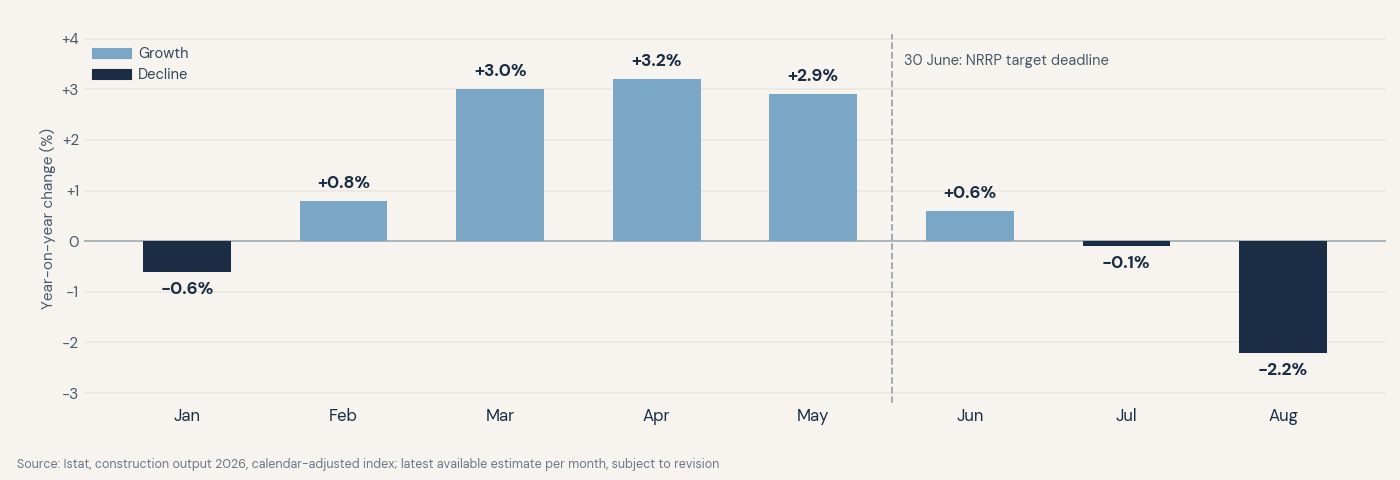
Construction output fell for a third month in August, to its lowest since December 2024. A link to the end of the NRRP is plausible but unproven: the index does not split public from private work, and the estimates are revised substantially.
In August Istat's index of construction output fell 2.9% from July. It was the third consecutive decline and took the level to its lowest since December 2024. Over June to August output was down 3.2% on the previous three months; calendar-adjusted, the comparison with August 2025 shows -2.2%.
The obvious reading links these figures to the end of the NRRP. The timing fits: 30 June was the deadline for the plan's targets, and output started falling in June. Before drawing a conclusion, though, there are three reasons for caution.
The index does not say who slowed down
The index measures total activity: residential and non-residential buildings, maintenance, civil engineering. It does not separate public from private sites. In January ANCE forecast 2026 construction investment up 5.6%, with public works up 12% in the plan's final stretch and residential renovation up 3.5%. In August, according to press reports, the association and the Infrastructure Ministry were asking for about €20 billion in extra funding, warning that without compensation for higher material costs some public sites could stop from September.
The summer decline fits that scenario. It also fits others: a slowdown in private maintenance while owners wait to learn the 2027 rate of renovation tax credits, or site delays caused by energy costs. Public data cannot separate these effects.
The estimates move a lot
The second reason is revisions. July's annual change, published in September at -1.2%, became -0.1% a month later. March came out at -0.2% and was later revised to around +3%. There is also a calendar effect: in August the raw index rose 2.3% year on year while the adjusted one fell 2.2%, because the month had one more working day than August 2025. On a series this volatile, three months of decline deserve to be taken seriously but do not prove a turning point, especially as activity in the first eight months is still up 1.2% on 2025.
Permits and prices tell another story
The third reason is that other indicators do not confirm the picture. In the second quarter, permits for dwellings in new residential buildings rose 8% year on year to 13,246 units, seasonally adjusted, and authorised non-residential floor space rose 5.1%. Volumes are low, but the direction is positive. On costs, producer prices for building construction are up 2.9% a year, far below the 10.9% for industry as a whole, driven by energy. Consumer inflation reached 4.2% in September.
The most likely picture is a two-speed sector. The tail of plan-related public works is thinning, while private new building is moving up from modest levels, constrained by the cost of credit and materials. This remains a hypothesis that the coming months will confirm or refute.
What matters for developers
For anyone planning a site start in 2027 the national index says little. What counts is the availability of contractors and subcontractors and the price obtained in tender. Fewer public works free up capacity and should make firms more willing to negotiate; energy and material costs push the other way. Which force prevails depends on location and type of work, and shows up more clearly in bids received than in aggregate statistics.
Three data points come next: the budget law, whose text should settle the 2027 rate of building tax credits; Istat's September figure, due in November; and third-quarter permits, out in mid-January. Until then the honest summary is that the summer brought a real slowdown whose main cause cannot yet be isolated from public data.