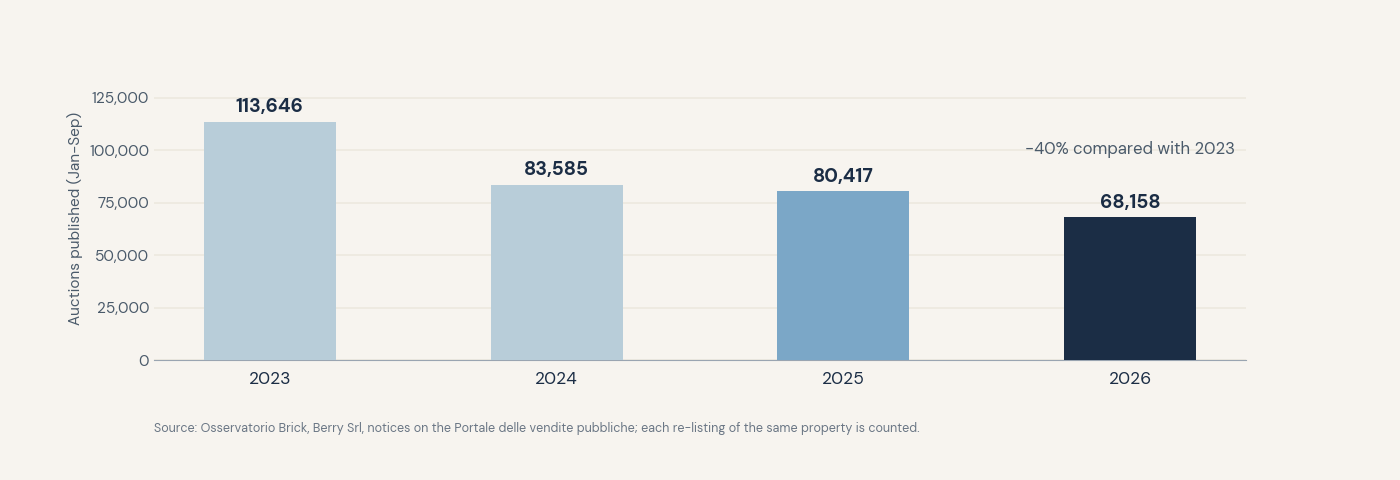
According to Berry's Osservatorio Brick, 68,158 auctions were published between January and September, 15.2% fewer than in 2025 and about 40% fewer than in 2023. In Milan they halved. The decline is solid; its causes, on public data, can only be inferred.
Between January and September 2026, 68,158 property auctions were published on the Portale delle vendite pubbliche, the official judicial sales portal, against 80,417 in the same period of 2025: a 15.2% decline, according to Berry's Osservatorio Brick. The total value of reserve prices fell from €13.55 billion to €10.75 billion, and the average from about €168,500 to €157,700.
The series is long and consistent. In the first nine months of 2023 there were 113,646 notices, in 2024 83,585. In three years the flow has fallen by about 40%.
Notices, not properties
Before reading these figures it helps to be clear about what they count. The Observatory records sale notices. If an auction attracts no bids, the same property is re-listed with a lower reserve, by up to a quarter, and counted again. Fewer notices can therefore mean fewer repossessed properties, but also more sales at the first attempts, or proceedings suspended or closed by other routes, such as a negotiated settlement or the debtor paying off the claim in instalments.
The same applies to values. Berry points out that the fall in the total also reflects the mix of assets and the price cuts on later re-listings, and should not be read as a general decline in property values.
Residential down, commercial steadier
Residential remains the largest segment, with 35,586 auctions and 52.2% of the total. Notices fell 16% and the average reserve 6.2%, to about €118,000. In commercial property the count fell by a similar 15.5%, while the average reserve rose 2.8% to about €180,000.
The most striking case is the City of Milan: 292 notices against 586, less than half, with the average reserve up 28.1% to about €272,000. Across the province the decline was 24%. One possible explanation is that, after several years of rising prices, smaller and peripheral units are sold before reaching auction, leaving the courts with the more expensive and harder-to-sell assets. It is plausible, but aggregate data cannot confirm it.
The credit cycle arrives late
The underlying driver is credit. Most recent proceedings stemmed from non-performing loans built up between 2011 and 2016, sold in bulk to funds and managed by servicers. That stock is running down, while new defaults have stayed low during years of cheap money and rising employment.
This may change. After the ECB's hikes in June and September, variable mortgage costs have risen, and according to data released in October almost one new mortgage in three was variable-rate in July. But the chain is long. Years usually pass between the first missed payment, repossession and the first auction, and the T6 Association puts the average length of a property enforcement at 4.85 years. Any rise in defaults linked to 2026 rates would show up in auction statistics no earlier than 2028, probably later.
Three possible readings
The fall in notices is solid; its interpretation much less so. If it mainly reflects the run-off of old loans, the flow will settle at a low level until the cycle turns. If it partly reflects more sales at the first attempt, it points to stronger demand at auction, consistent with asynchronous online sales rising to 48.9% of notices, or 58.5% including synchronous online sales, against 51.7% in 2025. If it reflects stalled or postponed proceedings, the volume has only been pushed forward. Public data cannot weigh these components, and estimates attributing the decline to a single cause should be treated with caution.
For auction buyers
For investors who use auctions as a buying channel the change is already visible: fewer small residential lots, more competition for them in cities where prices are rising, and a larger share of commercial and industrial assets that require different skills to value, vacate and re-let.
A smaller market that reacts slowly
The judicial channel is shrinking into a smaller, more selective market that reflects credit conditions with a lag of years. The 2026 auctions mostly tell the story of loans made more than a decade ago; those affected by this year's rates will come later, and only then will it be clear how much of today's decline was structural.