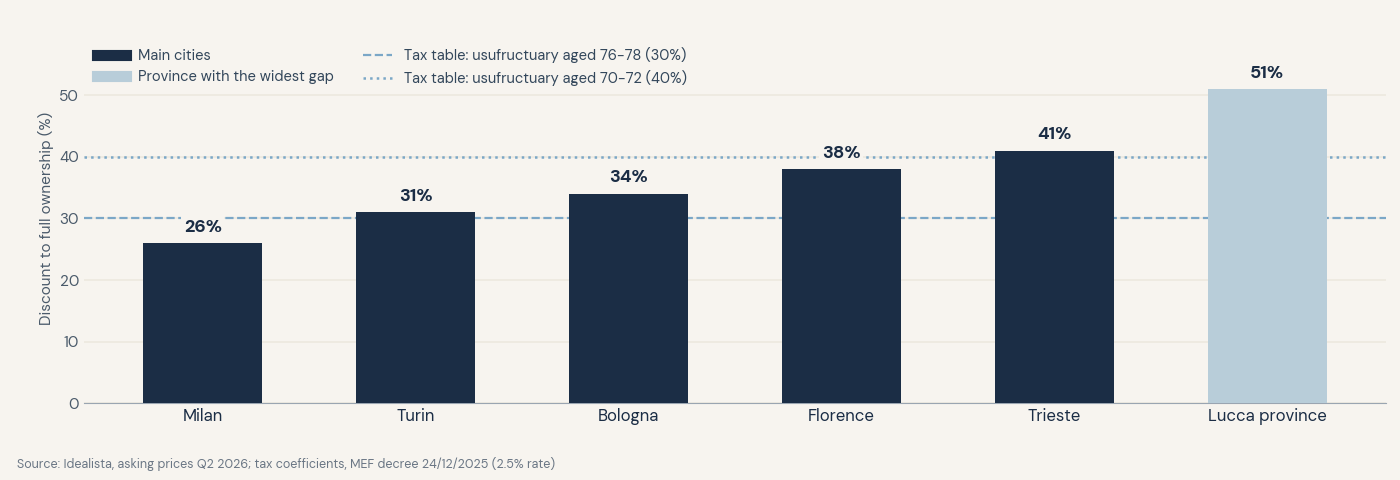
According to Idealista, bare ownership in Q2 was offered 26% below full ownership in Milan and 41% below in Trieste. The seller's age explains part of the gap; the property's yield, which the tax table ignores, explains another part.
In the second quarter of 2026, according to Idealista's research office, a home offered as bare ownership in Milan was priced on average 26% below full ownership. The gap was 31% in Turin, 34% in Bologna, 38% in Florence and 41% in Trieste. Among provinces, Lucca stood out at 51%. The format remains a niche: nationally, bare-ownership listings are just 0.6% of the residential supply.
The usual explanation for these differences is the seller's age. It is correct, but it leaves out half the story.
What the buyer actually acquires
The buyer pays today for a home that becomes available only when the usufruct ends, usually on the usufructuary's death. Meanwhile there is no income. Use of the property, or the rent if the usufructuary lets it, stays with the seller, who also pays IMU and ordinary maintenance; extraordinary works fall on the bare owner. Financially it is a zero-coupon instrument with uncertain maturity, redeemed in the property itself, together with whatever appreciation or depreciation has accrued.
The discount to full ownership is therefore, as a first approximation, the present value of the net income the buyer gives up during the wait. Two variables drive it: how long the wait lasts and how much the property yields.
Age sets the horizon, yield does the rest
The horizon depends on the usufructuary's age. Istat puts life expectancy at 65 at 21.4 years for 2025, and sellers of bare ownership are usually considerably older.
The second factor gets less attention but matters a great deal. Over an eleven-year horizon with a 3% net yield, the income given up is worth about 28% of the full price. With the same horizon and a 4.5% net yield it rises to 38%. One and a half points of yield are worth ten points of discount, for a seller of the same age.
Idealista's ranking is consistent with this reading at least at one end. Milan, which according to Tecnocasa has the lowest gross rental yield among the large cities, around 4.4%, also shows the smallest discount. Where prices have risen faster than rents, the forgone income weighs less on value and bare ownership is relatively more expensive.
Other variables in the sample
Yield does not explain everything. Bare-ownership homes are often older and larger than average, with works to budget for on repossession, which widens the discount regardless of income. Idealista also notes that the gap narrows from city to province and attributes this to higher full-ownership values in cities. The figures are asking prices and cover only areas with at least ten listings in the quarter, so city-level detail is indicative.
The tax table lives in another world
The tax authorities value usufruct and bare ownership using coefficients tied to the legal interest rate. For 2026 the legal rate fell to 1.6%, but the Ministry of Economy decree of 24 December 2025 kept the coefficients based on the statutory 2.5% floor. On that table bare ownership is worth 70% of full ownership if the usufructuary is 76 to 78, and 60% at 70 to 72.
These values exist to set the base for registration, inheritance and gift taxes. They apply the same rate in Milan and Trieste, ignore the condition of the property and assign the usufruct a conventional income. That the table's 30% falls close to the discounts seen in Turin or Milan is a coincidence, and using the coefficients as a price reference confuses a tax convention with a market estimate.
Who buys, and why
Demand comes from two directions: parents buying for their children at a lower outlay, and long-horizon investors with no need for current income. The second group should read the discount for what it is. Where yields are compressed the discount is small, and the deal works only if expected appreciation makes up for the income forgone. Where yields are higher the discount is generous, often because the market expects less from future value.
Seen this way, bare ownership is a way to buy a home's future appreciation without paying for its present income. The discount is the price of time and forgone income, and Idealista's figures suggest that in the large cities the market already prices it with some precision.