Iran, Hormuz, a halted Saudi pipeline and an uncertain Moscow-Kyiv truce have brought back inflation and ECB hikes. How the energy crisis reaches property, the 2022 precedent and three scenarios for the months ahead.
Since 28 February, when joint US and Israeli strikes on Iran opened what many now call the third Gulf war, European real estate has stopped pricing fundamentals and started pricing the oil barrel. September added a heavy piece. On the 10th a drone attack shut Saudi Arabia's East-West pipeline, roughly 7 million barrels a day of capacity and Riyadh's route around the Strait of Hormuz. At least three European refineries have had cargoes cancelled or pushed back to November.
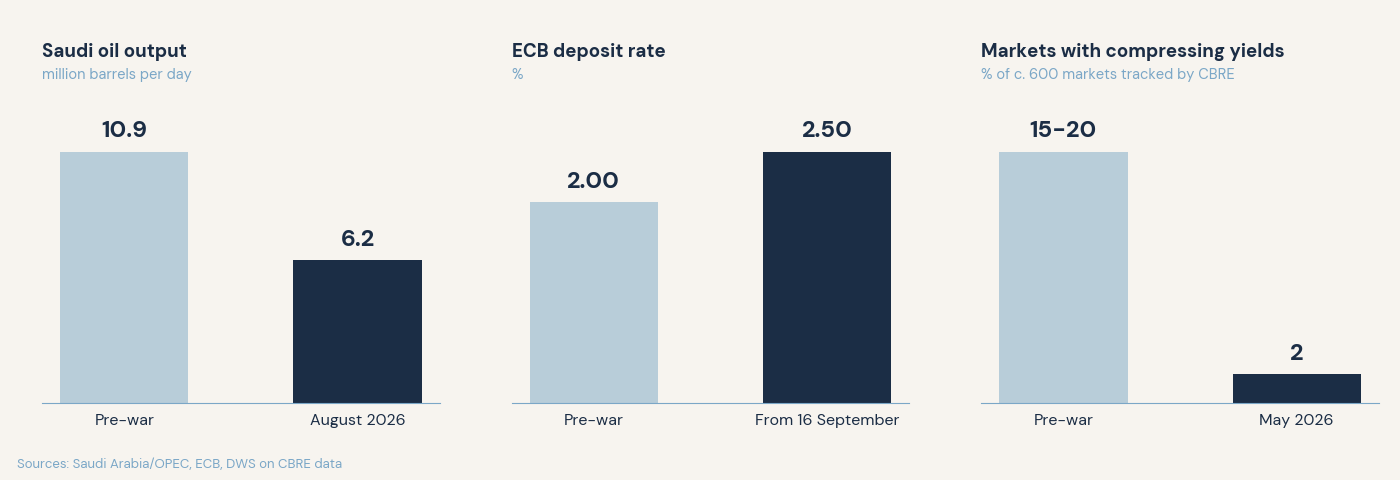
Saudi Arabia told OPEC that August output had already fallen to 6.2 million barrels a day, against 10.9 before the war. Brent reached $108 on 14 September.
In the east the picture is still open. Kyiv greeted the Russia-Ukraine energy truce announced by Washington that day with caution, and the IEEFA reports EU gas storage at 68% on 12 September, the lowest for the time of year since records began.
The transmission channel
A direct link between war and property prices is rare. The conflict works upstream: dearer energy lifts inflation, inflation pushes the ECB to tighten, and the cost of debt reprices assets. The full sequence played out in six months. Euro area inflation reached 3.3% in August, with energy at 14.3%, and on 10 September the ECB raised rates by 25 basis points for the second time this year, taking the deposit rate to 2.50%.
For real estate the decisive move came in swaps. DWS estimates that five-year Euribor swaps have widened by about 50 basis points since February and that European investment volumes fell by about 10% in the first quarter. CBRE supplies the clearest signal: before the conflict 15 to 20% of its roughly 600 tracked markets showed yield compression; by May the share was 2%.
The 2022 precedent
The script recalls the invasion of Ukraine. The gas shock then took the ECB deposit rate from minus 0.50% to 4% in little more than a year, European commercial values repriced by around 20%, and Italian residential sales fell by almost 10% in 2023 according to OMI.
One difference matters. In 2022 the starting point was negative rates and record-low yields. Today it is higher, and the room for a violent repricing is smaller.
Three scenarios
The first is de-escalation that reopens Hormuz by winter. Energy would ease, the ECB would pause and deals deferred in 2026 would land in 2027, helped by development pipelines at historic lows.
The second is stalemate, currently the most plausible. Italian growth near 0.3% in 2026, inflation close to 3%, flat nominal values and falling real ones. Northern logistics holds, with Lombardy vacancy below 4% and manufacturing supported by defence spending, and so do hotels, as dearer flights push leisure demand toward regional destinations. Secondary offices and non-prime retail suffer, since rent indexation at 75% of the Istat index cannot offset rising cap rates. UTP exposures tied to developments financed at pre-war rates and costs keep growing.
The third is widening: Red Sea and Hormuz closed together, a harsh winter on low storage, a Ukrainian truce that fails. The ECB would face a choice between inflation and recession, and non-prime repricing could exceed 2022.
The limits of forecasting
Uncertainty here is structural. Oil depends on military decisions and on repairs that industry sources put at five to six weeks, with no guarantee.
The market reading is ambiguous too. Some analysts see capital flowing into Europe, and Italy in particular, as war-driven safe-haven demand. It exists, but it is concentrated in trophy assets and a few cities, Milan first. Extending it to the whole market would be a misreading.
One point holds. Property hedges inflation only over the long run and only where income truly tracks it. In the short run war reaches real estate as the cost of money, and prices adjust with the lag typical of an illiquid market. The variable to watch in coming months is the spread between prime yields and five-year swaps, more than Brent: when it widens again, capital will return.