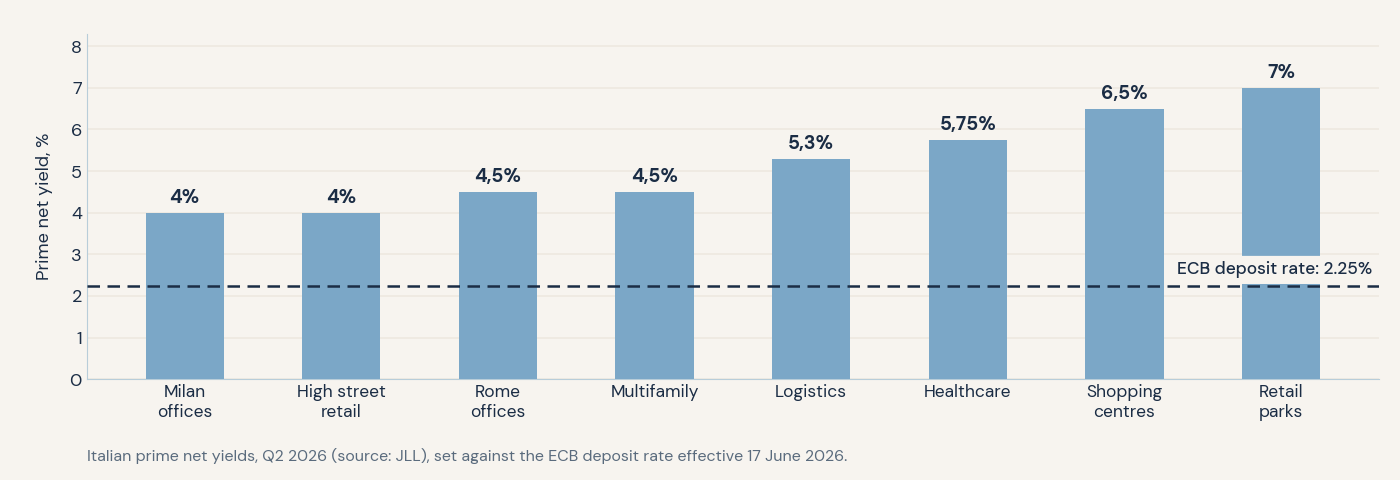
Italian prime yields did not move in the quarter the ECB reversed course. The spread over the risk-free rate is now thinner than for most of the cycle, and returns must come from rental growth.
How much margin is left, today, between the yield on a prime property and the cost of money? The question returned on 11 June, when the ECB raised its three key rates by 25 basis points, taking the deposit rate to 2.25% with effect from 17 June. It was the first increase since 2023, driven by inflationary pressure from the energy shock. On 23 July the Governing Council left everything unchanged, deferring any assessment to the September meeting.
Prime yields did not move
According to JLL's second-quarter reading, Italian prime net yields were broadly stable: 4.0% for Milan offices and 4.5% for Rome, 4.0% for high street retail, 6.5% for shopping centres, 7.0% for retail parks, 5.3% net-on-net for logistics, 4.5% for multifamily and 5.75% for healthcare.
That stability is itself information. In a quarter when the cost of money changed direction, pricing on quality assets recorded no adjustment. It is the normal behaviour of an illiquid market, where values form on transactions actually closed and transactions close months after the investment decision.
How we got here
The sequence of the last four years is well reconstructed in PwC's analysis of Italian real estate. Between 2022 and 2023 rates rose quickly and cap rates followed slowly, compressing the spread through lagged adjustment. Between 2024 and 2025 bond yields fell faster than cap rates decompressed, and the differential narrowed again, this time from the opposite side.
The gap between property yields and the risk-free rate is now thinner than it has been for much of the cycle. The illiquidity premium granted to the asset class has shrunk, and with it the safety margin available in the event of a shock.
The Milan arithmetic
Better done with the numbers in front. A prime office in Milan's central business district yields 4.0% net. The ECB deposit rate stands at 2.25% and the market prices the possibility of a further move by year end. The gross differential is therefore around 175 basis points, and out of that still have to come debt costs, maintenance capex, vacancy risk at lease expiry, and the technical obsolescence of a building that in ten years will face energy standards not yet written.
It is not a margin that forgives underwriting errors.
Where the return comes from now
With cap rate compression exhausted, the source of return shifts to rents. Cushman & Wakefield's second-quarter data show Milan prime office rents up 10% year on year, while Rome holds stable. In logistics, prime rents in Milan and Rome reached 72 euros per square metre per year, up 3% on the previous quarter, with half-year take-up up 50% and the strongest first half on record. In retail, Italian prime rents posted among the highest growth rates in Europe.
The shift is substantial for anyone underwriting deals. During compression it was enough to buy a stable income stream and wait for the denominator to fall. Now the return depends on the ability to grow the rent, which means asset quality, tenant strength, contractual indexation and scarcity of supply in the submarket. These are different skills, closer to management than to allocation.
The retail exception
The sector that drove half-year volumes is also the only one retaining a wide cushion. Core shopping centres sit around 6.5%, retail parks at 7.0%, and secondary product approaches 10%. Cushman & Wakefield has observed that retail is the asset class that did not experience the same value swings as the others, staying at depressed levels for longer. With roughly 2.2 billion raised in the half year, the market appears to have decided that gap should close.
The volume paradox
The first half of 2026 produced between 7 and 7.8 billion euros of investment depending on the perimeter used, the strongest in five years. Capital arrived while the cost of money was rising again and the available spread was thinning.
One explanation is that international capital, at 77% of second-quarter volumes according to Cushman & Wakefield, prices Italy against worse European alternatives rather than against its own absolute cost of capital. Another is that some buyers are purchasing rental growth rather than current yield, accepting a tight entry in exchange for a trajectory. The two readings are not mutually exclusive, but they imply very different horizons: the first holds as long as the relative comparison stays favourable, the second only as long as rents actually rise.