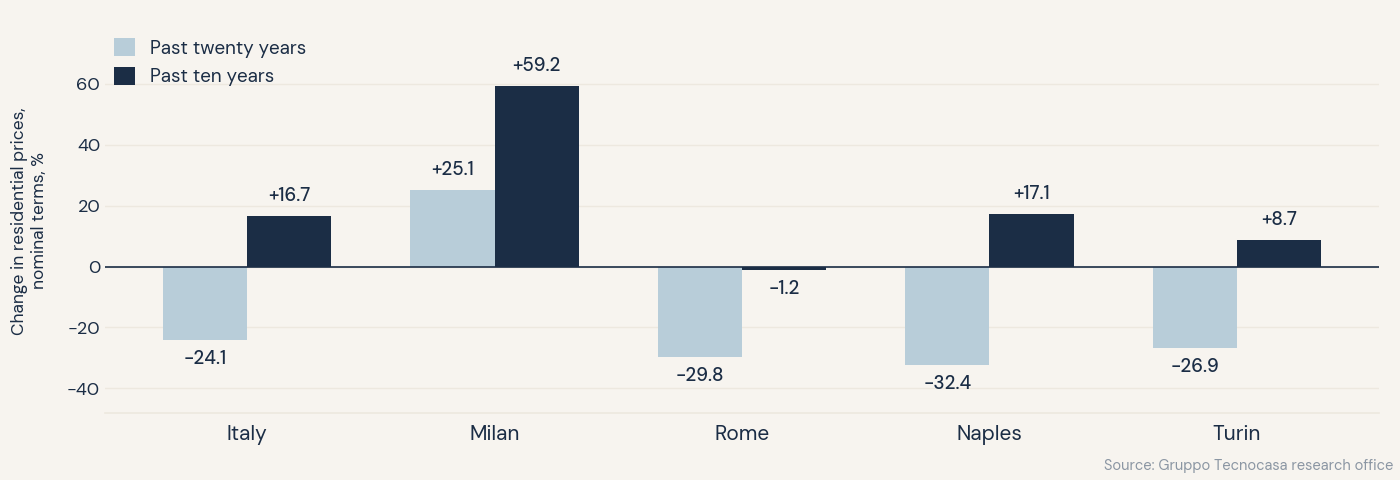
Over twenty years Italian residential values lost 24.1% in nominal terms, with Milan the only market in growth. Adjusted for inflation, even Milan's gain turns into a decline, and the return on property has to be looked for elsewhere.
Over twenty years, Italian house prices have fallen 24.1%. Naples is down 32.4%, Rome 29.8%, Turin 26.9%. Only one major city closes the period in positive territory, Milan, at 25.1%. The survey comes from the research office of Gruppo Tecnocasa, released on 2 September 2026 in the press note "La rivalutazione degli immobili nel tempo" and built on quotations from its own agency network.
The recent decade tells another story
Shorten the window to ten years and the picture reverses. Italian prices rise 16.7%, Milan leads at 59.2%, Naples recovers 17.1 points, Turin 8.7. Rome is the only one of the four still negative, at minus 1.2%.
Fabiana Megliola, who heads the research office, identifies the moment Milan turned: after the decline that began in the second half of 2007, in line with the national figure, the Lombard capital was the first to stabilise, already in the second half of 2016. The other markets took a further two or three years.
The missing number
These changes are nominal. Over the same twenty years the general level of consumer prices in Italy rose by more than 40%.
That adjustment changes the nature of the picture. The national 24.1% decline becomes a real loss of purchasing power close to 45%. Milan's 25.1% gain, the only positive figure in the whole survey, turns into a real decline of around 10%. None of the four markets preserved, over twenty years, the real value committed to property.
Why housing remains a widespread investment anyway
The paradox is only apparent, and it resolves once financing is taken into account. A buyer who purchased in 2006 with a twenty-five year mortgage repaid the debt in progressively devalued currency: the same inflation that eroded the real value of the asset eroded the real value of the debt, and on the financed portion the two effects offset. Add the rent not paid, which over twenty years on a primary residence represents a flow comparable in size to the capital invested.
The return on Italian residential property has never been in appreciation. It lies in the combination of leverage, monetary erosion of debt and imputed income. Price statistics capture one component, and not the main one.
The arithmetic changes entirely for a buyer who paid cash, and for a second home kept available. There the real loss is full, offset neither by debt erosion nor by rent avoided, and it accumulates alongside twenty years of property tax on a cadastral base that no reform revised downwards while market values were falling. A substantial share of Italian household property wealth sits in exactly that position, and it is also the share now feeding the supply of listings in weak-demand areas.
Price statistics do not separate the two cases.
Milan is not a replicable model
Milan's 59.2% over the decade measures a concentration, not a national trend. Skilled employment, foreign capital, the university system, regeneration of large former industrial sites and a planning regime that until recently allowed widespread densification all operated together, in one place.
Rome, within the same monetary cycle and the same credit demand, closes the decade at minus 1.2%. Sixty points of divergence between two cities in the same country cannot be explained by interest rates.
Turin shows the opposite mechanism. Its 8.7% recovery over the past decade starts from a base compressed enough to make buying competitive against renting even on middle and lower incomes. That is a recovery driven by price level rather than by strength of demand, and it stays sensitive to any change in the cost of credit.
What these figures say, and what they do not
Tecnocasa data come from an agency network and cover mainly mid-market existing stock. Istat's IPAB index, built on a different basis, shows a milder long-run decline. The direction is the same, the levels are not interchangeable, and the two series should not sit in the same chart.
Twenty years of data show that Italian residential property stopped being a single market some time ago. The national contraction is the sum of diverging paths, and the divergence widened during the recovery itself. Anyone appraising a property outside the top five markets today is working on an asset that, in real terms, has lost close to half its value in a generation, and whose future demand rests on a demography that in most Italian municipalities subtracts population rather than adding it.
Source: Gruppo Tecnocasa Research Office, "La rivalutazione degli immobili nel tempo", press release of 2 September 2026 (in Italian)