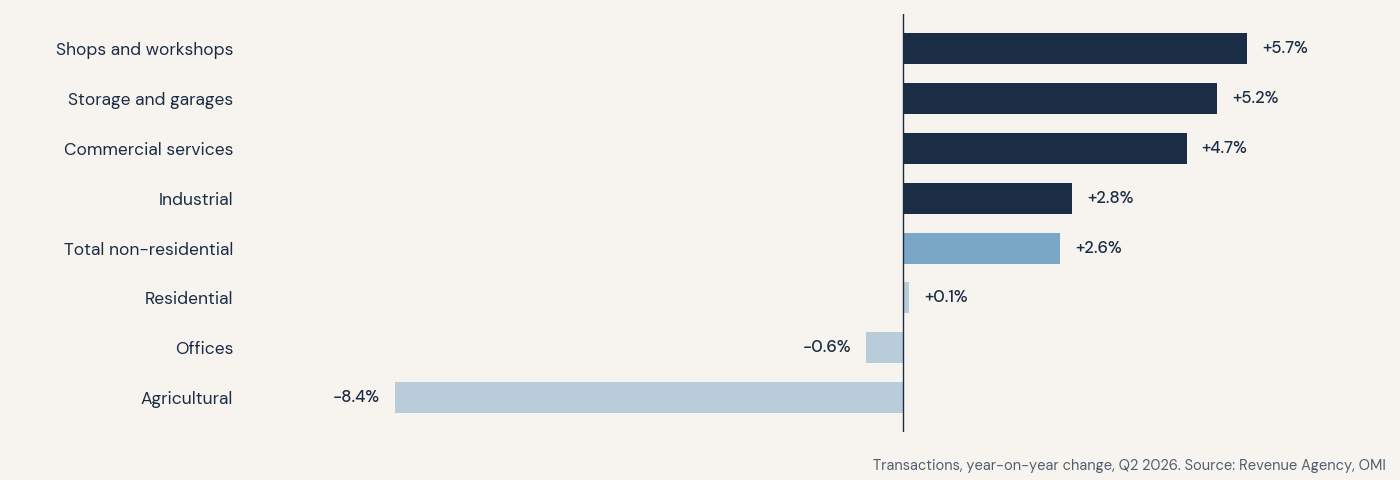
In the second quarter of 2026 shop and workshop sales rose 5.7% and traded floor area 7.7%, while offices slipped 0.6%. The Revenue Agency data point to larger units and to buying outside the main cities.
In the second quarter of 2026, 12,226 shops and workshops changed hands in Italy, 5.7% more than a year earlier. Floor area traded grew faster than the number of units: +7.7%.
The figures come from the quarterly statistics of the Revenue Agency's property market observatory, published on 10 September. They put small retail at the head of a non-residential segment that rose 2.6% across more than 66,000 transactions. Commercial storage and garages grew 5.2%, the commercial-services segment as a whole 4.7%, industrial 2.8% with 4,294 sheds. Offices slipped 0.6% to 3,541 units, agricultural property fell 8.4%. Residential was flat at +0.1%.
More square metres per deal
When floor area grows faster than transactions, the average unit size rises. For shops, part of the buying concerns spaces larger than the typical neighbourhood unit: medium formats, merged units, ground floors with back rooms and storage.
Offices show the same pattern more sharply. Transactions fall, floor area rises 1.9%. Fewer, larger deals, consistent with what the office market has shown for some time in the big cities.
The provinces outbuy the main cities
Outside provincial capitals, shop sales rose 7.3%; inside them, 3.1%. For industrial sheds the concentration is starker: 86% of trades happen outside provincial capitals.
In smaller towns a ground-floor shop costs a fraction of its urban equivalent, gross rental yield is often higher, and buyers include artisans and small firms buying for their own use. These deals rarely pass through institutional channels, so they are absent from investment reports.
The eight largest cities
Across the eight main cities shop sales rose 4%. Genoa posted +29.8%, Palermo +14.5%, Bologna +14%, Milan +7.6%. Rome was the only large market in decline, at -2%. On small absolute numbers such swings need caution; what matters more is that growth spans every macro-area.
Use and price
The quarter describes demand for property to be used straight away: the shop you work in, the store, the garage, the shed near the business. For these buyers the cost of money matters less than for a fund, because the alternative is a rent that keeps rising.
There is a less flattering reading. Some of the shops changing hands have been vacant for years and now sell because asking prices have finally aligned with the income they can generate. Volume data cannot tell the two cases apart.
For mixed portfolios the signal is about liquidity. The commercial ground floor in a mid-sized town has long been the hardest asset to dispose of. If the second half confirms this pace, such assets become saleable again within reasonable timeframes, and their weight in portfolio valuations deserves revisiting.